

You have likely heard the term ‘learning styles’ in the context of education and training. Simply defined, learning styles refer to the methods that individuals use to comprehend and retain information. The seven widely recognized learning styles are often viewed as a combination of Neil Fleming’s VARK model, which focuses on sensory modalities (visual, auditory, reading/writing, kinesthetic), and Howard Gardner’s Theory of Multiple Intelligences, which expands the concept to include various forms of intelligence.
You may also wonder how learning styles are relevant to your work with children and families. And that’s a great question! One we will explore in this post. Let’s start by identifying the seven learning styles.

Want to share this information with your team? Download CalTrin’s ‘The Seven Learning Styles: What’s Your Mix?’ infographic!
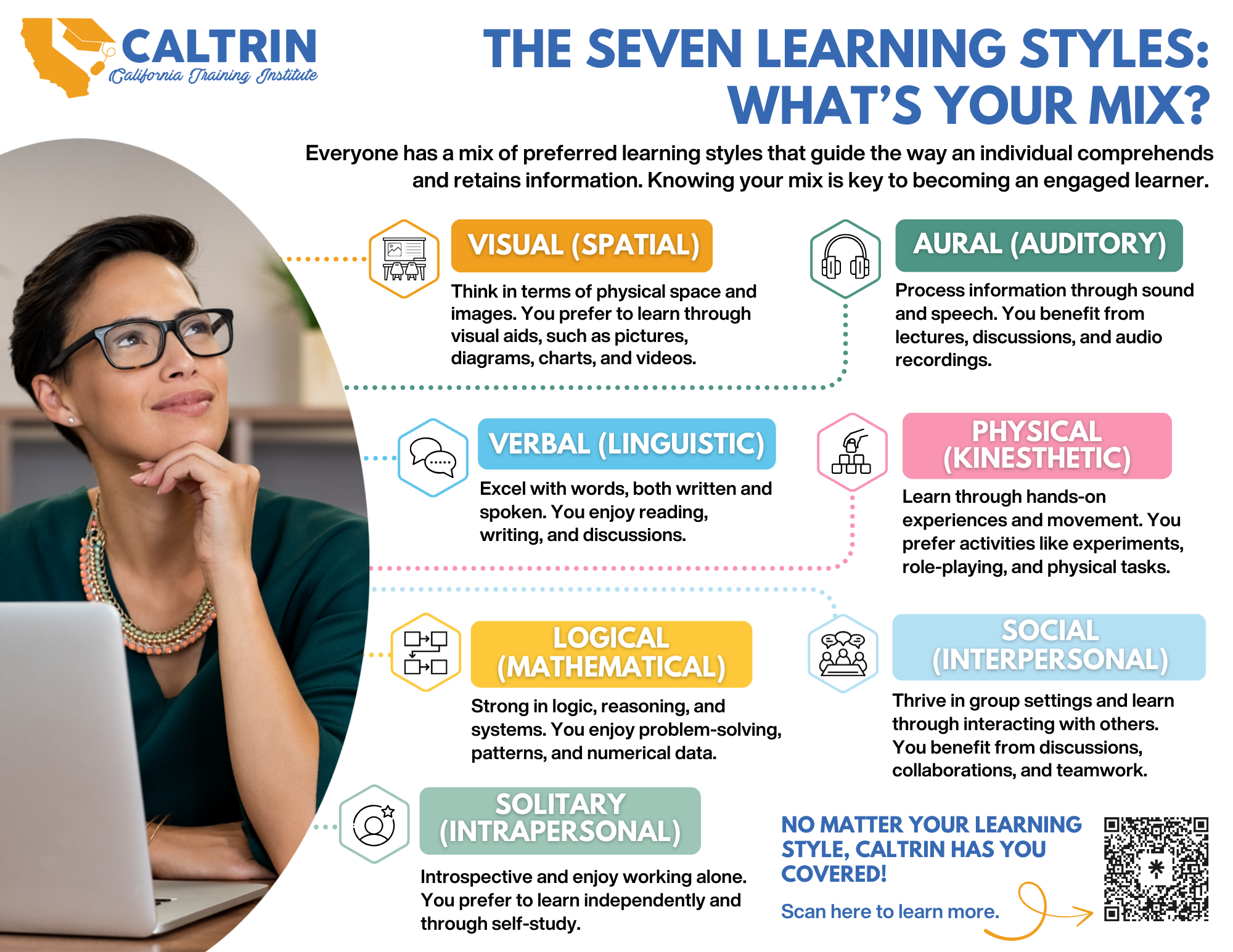
Identifying + Understanding Your Preferred Learning Style
Everyone has a mix of preferred learning styles, which guide the way an individual represents and recalls information. Learning style assessments or questionnaires are excellent tools for helping you identify your preferred way of learning. These assessments categorize learners into different groups based on how you process information. By understanding your learning style, you can then tailor your professional development and learning strategies to suit your preferences. When you learn in a way that aligns with your style, you can better understand and retain information. Learning also becomes more enjoyable and engaging when you use methods that resonate with you.
For child- and family-serving professionals, understanding your learning style can help you to adapt to different training methods within your workplace, collaborate more effectively with colleagues, and advance your professional development goals. We encourage you to experiment with various learning methods and pay attention to what works best for you. Reflect on your past learning experiences and consider what strategies have been most effective. Don’t be afraid to try new things and adapt your approach as needed!
Discover your preferred learning style(s) with these free assessments and questionnaires:
- Marcia Conner: What is Your Learning Style?
- Learning Styles Online.com: Discover your Learning Styles – Graphically
- Learning Style Quiz: Free Learning Style Quiz: How Do You Learn?
- Practical Psychology: What is your Learning Style? (Free Test)
- VeryWell Mind: The Intelligence Type Test: What Kind of Intelligence Do You Have?
Match Your Learning Style with CalTrin’s Training Options
So, you’ve identified your individual learning style, now what? It’s time now to match your individual learning style with CalTrin’s training options! To start, let’s review how learners engage with CalTrin:
- By attending live, virtual training (webinars and workshops)
- Completing self-paced courses
- Exploring our extensive archive of recordings and materials (replays and microlearnings)
What is the difference between a Webinar, Workshop, and Self-Paced Course? The answer to that can be found in our companion post, Which CalTrin Training Option is Best for Your Learning Style?, where we outline some of the key differentiators and elements of each type of training event to help you decide which format best fits your needs. For a quick recap of CalTrin training options, check out this handy table.

Now, let’s see how CalTrin training options match up with the seven learning styles. Below, you will find recommendations for the CalTrin training option(s) that best align with each learning style.
- Visual (Spatial) Learners:
- Recommended CalTrin Training Option: Webinar, Workshop, Self-Paced Course
- Recommended CalTrin Training Option: Webinar, Workshop, Self-Paced Course
- Aural (Auditory) Learners:
- Recommended CalTrin Training Option: Webinar, Workshop
- Verbal (Linguistic) Learners:
- Recommended CalTrin Training Option: Workshop
- Recommended CalTrin Training Option: Workshop
- Physical (Kinesthetic) Learners:
- Recommended CalTrin Training Option: Workshop, Self-Paced Course
- Logical (Mathematical) Learners:
- Recommended CalTrin Training Option: Self-Paced Course
- Recommended CalTrin Training Option: Self-Paced Course
- Social (Interpersonal) Learners:
- Recommended CalTrin Training Option: Workshop
- Recommended CalTrin Training Option: Workshop
- Solitary (Intrapersonal) Learners:
- Recommended CalTrin Training Option: Self-Paced Course
It’s essential to acknowledge that individuals respond to a variety of learning styles, rather than a single, specific method. Knowing your mix is key to becoming an engaged learner. We look forward to seeing you at an upcoming CalTrin training that meets your unique learning style!
Additional Resources
BetterUp: How Different Learning Styles Make a Difference at Work
California Learning Resource Network: What Are The 7 Different Learning Styles?
Center for Innovative Teaching and Learning at Northern Illinois University: Howard Gardner’s Theory of Multiple Intelligences
Comeandsee Global Limited: Catering to Different Learning Styles With e-Learning (Infographic)
eLearning Industry: Training Employees According To Their Learning Style
EmployeeConnect: The 7 Learning Styles: What’s your Learning Style?
Indeed.com: Learning Styles for Career Development
SimplyPsychology: Gardner’s Theory of Multiple Intelligences
Teachings in Education: Learning Styles & Multiple Intelligences: Theory Integration (6:38) – Education-focused explanation but applicable to workplace/training scenarios
VARK Learn: VARK® Modalities: What do Visual, Aural, Read/write & Kinesthetic really mean?
Last updated August 29, 2025